Monday, July 20, 2015

Little Piece of Heaven


Does Punkhorn Road sound inviting?  (What is a punkhorn anyway?)  Well, I decided to explore this puzzle one morning in mid-July.  The road sign is at the west end of Long Pond in Harwich.  I've passed this spot a hundred times while traveling Pleasant Lake Road but never had the inclination to stop until today.      


The entrance doesn't seem like a road to anywhere.  In fact, it looks like a private driveway, but with tentative steps I found that the road continues to the right of the fluttering American flag.  Residents were tending their gardens and paid me no mind.


The road turned out to be very inviting.  Who doesn't like a woods road arched over with lush trees and bushes?  Where will this path lead?  


Surprisingly, there are a number of residences along the way.  The properties border on Seymour Pond, a peaceful retreat from the bustle of crowded Cape summers.      


The houses are a throwback to old Cape Cod with pretty flowers in rustic display.  


Take for example, this classic camp, having huddled on the pond shore for over 100 years.  


The owners proudly display this creative memorial to the 1909 founding.


My favorite is this little piece of heaven, tucked neatly into the Punkhorn.  What a fantastic getaway!!  Here, surely all your troubles can be forgotten.


I can't help but include a photo of this Eastern Phoebe, a resident of the parklands who patiently tolerated my presence in his domain.  Today, I solved the puzzle of Punkhorn road to my satisfaction and found a little piece of heaven.


Sunday, February 15, 2015

Worlds Apart

Temperature in the low 20's, another blizzard in the forecast, of course this was a great morning to walk the beach on the outer Cape.  There was one other lonely car in the parking lot.  I pulled on my hooded parka awkwardly while sitting in the front seat and made sure I had notebook, pen, camera and binoculars at the ready.  Much of this checking of gear admittedly was a form of procrastination. Who really wants to walk the beach in such ghastly weather?

Coast Guard Beach mid-February
The path down to the shore was a glaze of ice, packed solid by other intrepid walkers after previous snows.  So many of us are drawn to see the pounding spray of surf even on the worst of days.  I stepped carefully trying for patches of untrodden snow to insure traction.

The first bird of the day was a scraggly crow who greeted me rudely with hoarse gravelly caws from the roof of the old Coast Guard storage building.  I didn't feel welcome.

I burst unexpectedly onto the beach from the narrow eroded path between the dunes and surprised a coyote (actually a coywolf common on the Cape these days) who was trotting down the shore in my direction.  He stopped, stiffened and startled.  We stared eye to eye for a brief moment.  He turned abruptly and bounded back the way he had come, invisible in the dunes within seconds.  We clearly come from different worlds, I out of my cozy living room with a gas-fireplace and he always in this cold, unforgiving wildness.

Coast Guard Beach mid-February
The winter beach has a bruised and battered look, well-earned through harsh nor'easters.  The relentless storm-driven breakers have done their work this season.  The clinging dune grasses have lost a few more feet to the sea.  Waves are creeping slowly toward the old Coast Guard station.

Eroding dunes in front of the old Coast Guard Station
Walking was easy, the sand packed hard and partly frozen, the footing unusually firm.  I concentrated on quick strides in the attempt to keep warm and reached the southern end of the spit in a short half hour.  The appearance here has changed markedly from the summer.  The southern one-third of the spit has been over-washed in the surges of recent storms and looks fragile and forlorn.

Sanderlings mining the flats    February
But there is life on this desolate sandscape.  Delicate sanderlings were pecking at the surf in their hurried way.  They are loyal to these frigid sand flats through all the cold months.  Somehow they survive.  I stopped for a quick picture, despite the chilling wind.

Hesitant killdeer on the frozen marsh
I returned on the inside of the spit along the frozen edge of the marsh.  Here I met a lone killdeer who looked lost and bewildered on this Cape imitation of tundra.  He was hesitant to go as if curious about the world I had come from.

Northern harrier on the prowl
Further on, a northern harrier glided over the sparse dune grasses.  He paid no attention to me as I fumbled to focus my camera.  I was hoping that he didn't have a searching eye on the innocent killdeer.  But he seemed to already have something within his claws.

I hurried back to the car ahead of the approaching afternoon storm.  The wind had become narrow and biting.  Having briefly visited the harsh winter world of coywolf and bird, I was thankful that I could return to a cup of steaming hot chocolate in front of the fire.


Sunday, February 8, 2015

The Perilous Plight of Piping Plovers


Why all the fuss over these cute little birds?   

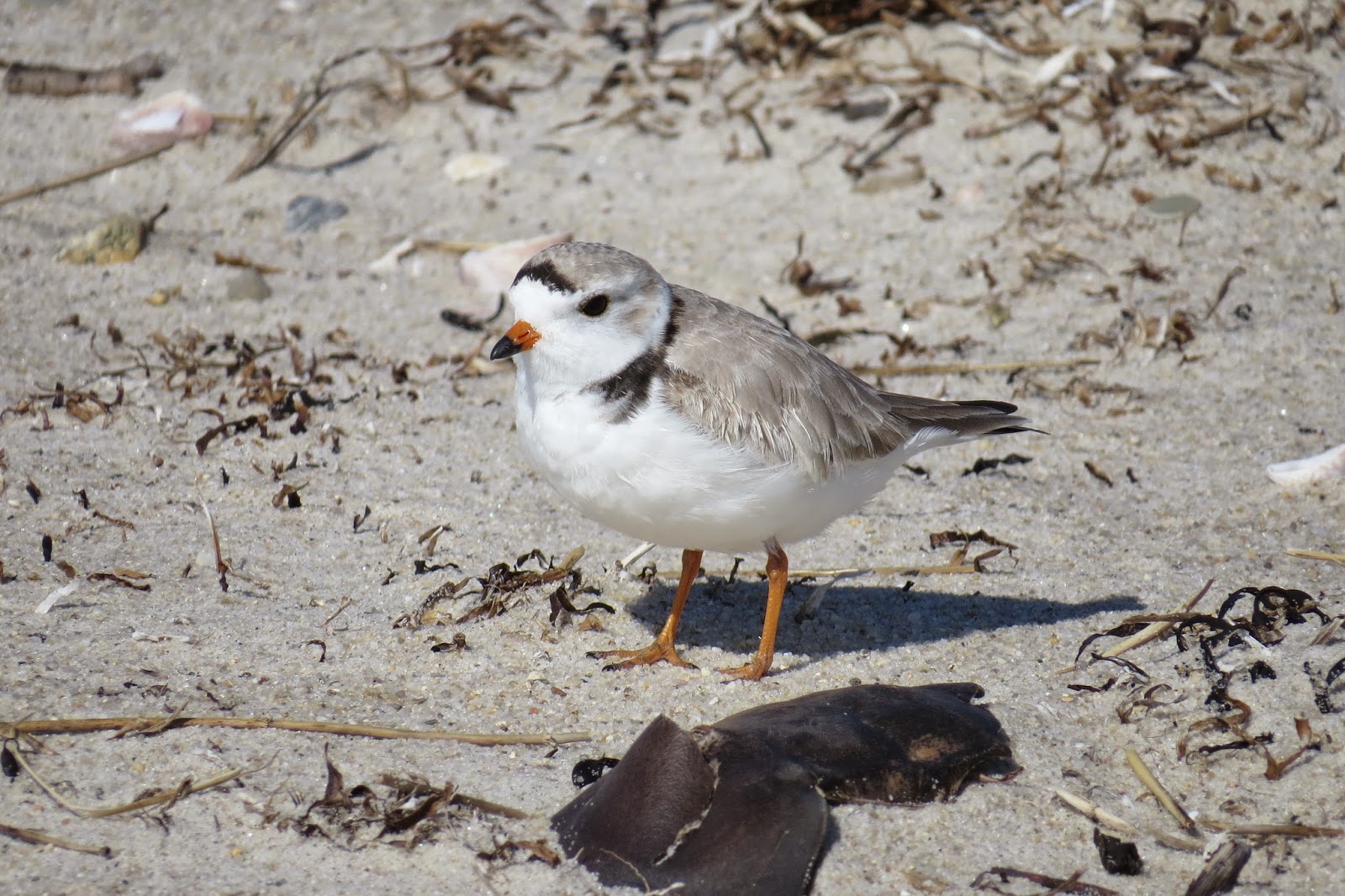
I photographed a number of these fellows last spring on Hardings Beach in Chatham upon their arrival from the south.  Since then I have listened to both preservationists, beach-goers, and off-road vehicle (ORV) owners voice their varied opinions.  One frequently hears how plover meat tastes quite good, like chicken.  It's quite a lively debate.

Hardings Beach 4/3/14 
The piping plover is designated as a "threatened species" on Cape Cod.  

Shore birds were first stressed in the 19th and early 20th century by hunters who collected feathers for sale in fashion markets.  When beaches became very popular for humans to visit in the 40's and 50's, plovers were especially stressed as we gradually took over their natural breeding grounds.  Their numbers dropped and their survival became threatened.

The National Seashore, the National Fish and Wildlife Service and many of the towns on the Cape are going out of their way to preserve these birds.  Nesting sites are protected during the breeding season from the time shallow nests are scraped in the sand until hatched chicks can take to the air. This is an inconvenience to beach-goers and ORVs who want access to the beaches.  ORV restrictions can stretch from May through July.  

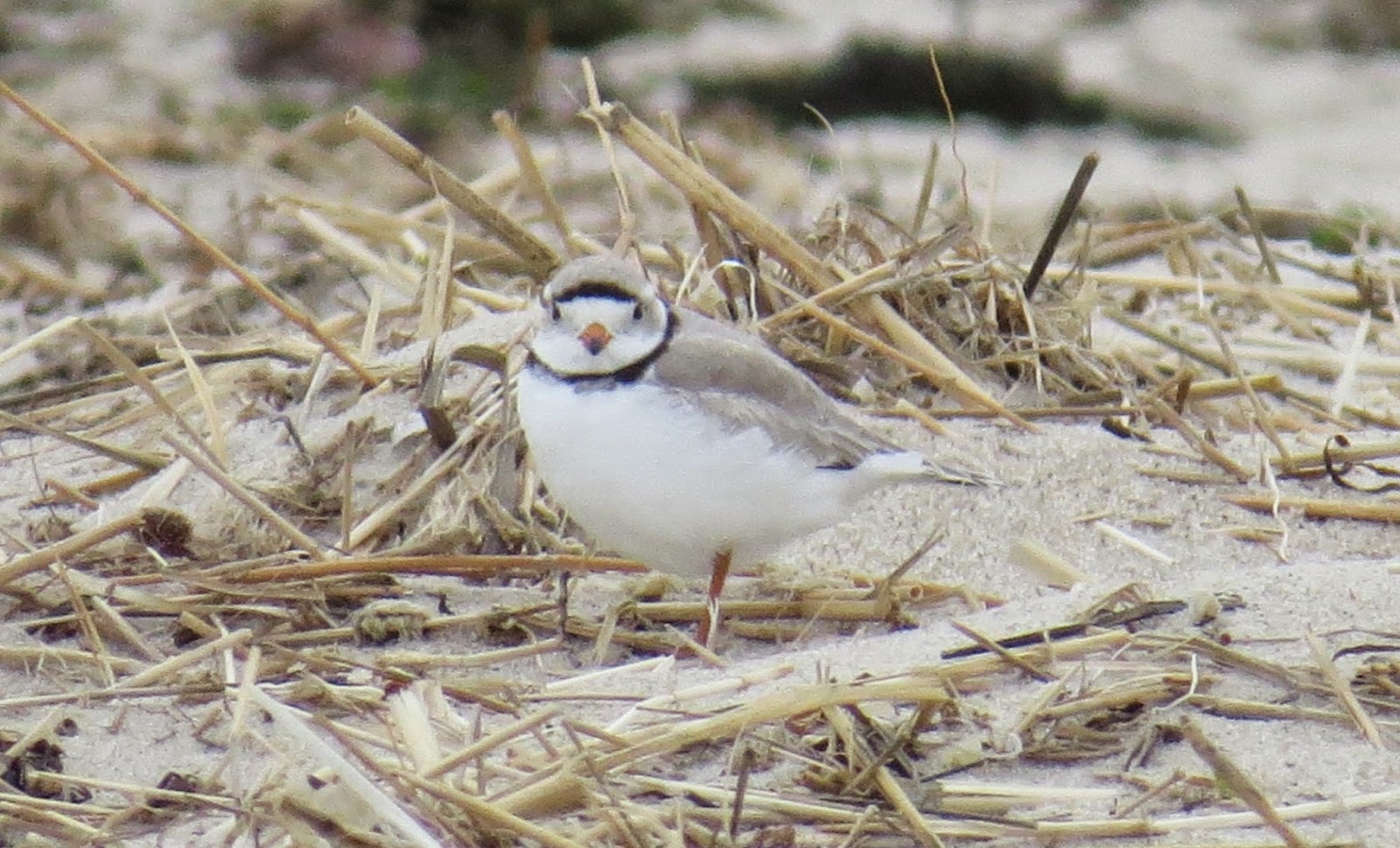
The coloring of these birds makes them very difficult to see, even if you are looking carefully.  The nests and eggs are even more difficult to spot.  Sand-colored eggs take about a month to hatch. Chicks do not take to the air for about a month after hatching.  During the period when chicks scurry up and down the beach to feed, they are extremely vulnerable.  In addition, chicks burn precious energy to avoid beach walkers and ORVs.  For these reasons breeding areas are roped off and vehicle travel is prohibited during critical periods.

Plovers are very well camouflaged in a beach environment.  Hardings Beach 4/3/14
Why are we going to so much trouble to save these little guys?  

"Threatened species" are legally protected under the Endangered Species Act of 1973.   The purpose of the act is "to halt and reverse the trend toward species extinction, whatever the cost."  But why are we so concerned about species extinction?  Biologists (e.g. Harvard's Edward O. Wilson) estimate that the rate of global species extinction is 1,000 to 10,000 times the background rate.  The background rate is defined as the rate of species loss before the influence of man.  We (humans) are the cause of the greatest rate of species extinction since the time of the die-out of the dinosaurs, 65 million years ago.

My barber raises a question about species loss.  

During a recent visit to get my thinning and graying hair trimmed at our local barbershop in Brewster, I got into a discussion about these plovers.  My barber is very astute.  He informed me without hesitation that we are in the middle of a mass extinction event.  He implied that because we are losing so many species each year, perhaps we are expending too much effort to save these particular little guys.
Piping plover pondering my presence in his/her potential breeding area.  Hardings Beach 3/29/14  
This raises a practical question.  Should we look at the big picture of species extinction? Presumably we have a limited number of resources that can be devoted to saving species.  Maybe we could save more species by using the funds devoted to plovers on Cape Cod to instead preserve the Amazon rain forest.  I assume species are disappearing more quickly in places like the Amazon basin as opposed to Cape Cod.  Diverting funds to slow species extinction in a different part of the world would certainly be welcomed by Cape Codders who wish to drive their ORVs with more abandon on Cape beaches.

Let's save the plovers.  

The above argument is an easy cop-out.  Shouldn't we try to control our local environment as best we can?  We have much less control over ecosystems in other parts of the world.  So I am for the protection of the piping plover here on our beaches.

Secondly, what would the vacationers say if they learned that we are sacrificing this cute species to please beach-goers and ORV drivers who don't wish to be inconvenienced by restrictions?  I don't think this would help to enhance the public perception of our "pristine" Cape Cod.  At this point, images of plovers have become iconic on the Cape.

Finally, our presence on Cape beaches initially stressed the plover breeding habitat.  Don't we owe it to these birds to do what we can to insure their survival as a species?  We can't be so arrogant to think that our species is more important than theirs.  (Or are we?)


Monday, November 17, 2014

Pamet Roads in the Late Autumn

In the heathland

Go to Pamet Roads in the late autumn.  Leave behind the anxiety of modern living.  Walk the sandy paths through the heath toward the sea.  


Shed near former cranberry bog

Pass the remains of an old cranberry bog, overgrown with twisted shrubs and leaning saplings.  Read about the family that harvested here every fall for generations.


Old bog house

Puzzle over the second floor entrance to the old bog house.


Grass covered dunes next to the sea

Choose a comfortable seat on the side of a grassy dune.  Eat your lunch slowly.  Savor the sweetness of your apple while gazing over the wide sea.  

Dune cliffs

The beach below is deserted on this November afternoon, yet you don't feel lonely.


View to the northeast

Pause frequently to take in the many soft-colored views.

View to the southeast

Abandoned road partially covered during dune washover

The low dunes at Ballston Beach have been overwhelmed many times through the decades by the pounding ocean surf.  Huge breakers have surged into the fresh water marsh at the head of the Pamet river.


Fresh water marsh at head of Pamet River

Residents have placed warning signs asking visitors to tread lightly on the narrow barrier that separates the sometimes angry ocean from the fragile marsh.    


Hooded merganser on pond behind barrier dunes

At the end of your stay be as relaxed as these merganser floating peacefully amid shimmering reflections on this small pond.  So please, I urge you, go the Pamet Roads in the late autumn.


Sunday, November 2, 2014

Disputed Boundaries and Cape Coyotes

Nauset Spit

looking north toward Nauset inlet

Last week I walked along Nauset Spit from Priscilla's Landing to get some exercise and search for birds.  The Atlantic beach is about a half mile to the east from the parking lot at the landing.  The shoreline can be followed north for about 2 miles to Nauset marsh inlet.  Most of the dune and grass area above the high tide mark is posted to prevent dune erosion and protect nesting sites of endangered birds.  

Boundary

Permits can be purchased from the Town of Orleans to drive vehicles on the beach toward the inlet.  In recent years the inlet has been gradually migrating north due to the natural movement of sand caused by wave action and ocean currents.  This had lead to a controversy about who has jurisdiction over the northern portion of the spit.  Eastham officials claim that the new section of the spit is now within their town.  Orleans selectmen maintain that the northern section should remain under their control at least for the management of off road vehicles.  Recently, the National Park Service claims that this section is actually the property of the National Seashore.  Currently, there are signs about half way up the spit to prevent Orleans off road vehicles from driving into the Town of Eastham. There continues to be a legal tussle over this stretch of sand.  

Coyotes

As I approached the line of dispute, the signs became visible.  I also noticed a coyote disappearing into the dune grass behind the boundary.  I was curious and in no way surprised.  Coyote sightings have become very common on the Cape.  Most full-time resident tell stories of coyotes strolling through backyards and there are frequent reports of attacks on pets.  In rural areas howling packs can sometimes be heard during late night hours.  I heard a pack singing their mournful serenade for the first time in our Harwich neighborhood about a week ago when I awoke at 3 in the morning.  The cries made my heart beat faster and sleep returned slowly after the yelps subsided.       

coyote disappearing into the dunes

sign at the disputed boundary

I continued to stroll up the beach and after walking for another half mile, I noticed what I first thought was a large dog ahead on the beach.  Binoculars, however, showed this to be another coyote.

another coyote in the distance

This guy was reluctant to flee into the dunes.  Food was involved.  He was trying to drag the remains of a seal to a safer area.  

trying to drag his lunch to a protected area

As I approached, he finally decided to slink off.

slinking coyote

After a few minutes, I passed the remains of the seal and continued walking north.  After I had gone another 50 or 75 yards, I turned to look back down the beach and saw that the wily coyote had returned to complete his meal.  He was closer than before and I snapped a pretty good picture.

return to finish the meal

He is certainly a healthy looking specimen, well-fed and well-groomed.  He didn't appear to be overly concerned about my presence but I'm sure he was glad to see me depart.  These coyotes must be ecstatic over the property line dispute as they cannot enjoy dodging off road vehicular traffic.  Further along the spit many coyote tracks were obvious crossing back and forth between the marsh and the ocean.

In conclusion, there are three government organizations feuding over the north end of the spit, but the real story is that the coyotes have squatting rights and currently have real jurisdiction.

End of the Walk

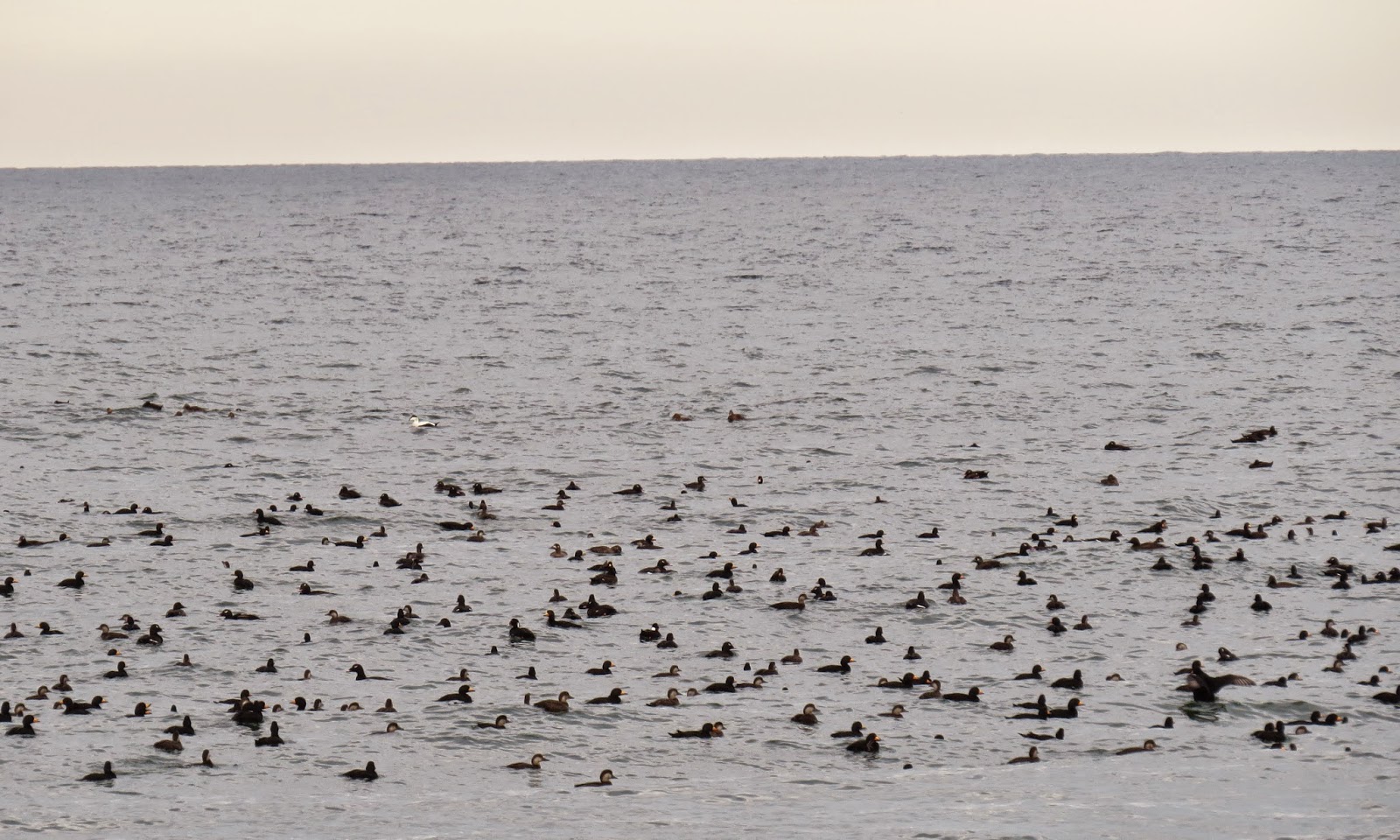
A huge flock of birds were floating in the sea near the inlet.  There were hundreds, mostly black scoter and white-winged scoter with some surf scoter and common eider mixed in.

floating birds (only a section of the flock is shown)  

I returned on the marsh side of the spit as the afternoon waned.

late afternoon sun and clouds over the marsh

Another fine Cape afternoon had passed.  A great deal had been accomplished.  I had burned some serious calories and as a bonus had sighted a huge flock of scoter.  Finally, I had acquired a firsthand understanding of the species that has practical jurisdiction over the north end of Nauset Spit, at least until an agreement can be hammered out between the towns and the National Park Service.
  

sunset from Priscilla's Landing

Friday, October 24, 2014

Wildlife in the Refuge


On this balmy autumn afternoon wildlife was in the  refuge.  Humans were few.  Birds were abundant.  Vireos and warblers were preparing for their southern migration.        

blue-headed vireo

yellow-rumped warbler

Others were making tracks in the sand.  
tracks

 It's tough to see the four-footed track makers, let alone get a photo.  Luck played a large part in snapping this coyote just before he was swallowed by the marsh grass.

making tracks

Another transcendent day on the marsh.

looking east towards South Beach 


Thursday, October 2, 2014

Protests and the Fall of the Wall

Hong Kong residents are taking to the streets this fall, protesting Beijing's oppressive influence on planned elections in their city.   Will these demonstrations succeed?  Could there be a repeat of the brutal crackdown of Tiananmen Square, the horror of June 4, 1989.  Or will there be a peaceful outcome?  

Normally this blog chronicles quiet walks of a retiree on Cape Cod beaches and marshes but retirees have time to travel, and travel sometimes leads to contemplation of world events.  In this entry, I give some photos and comments from a visit that Mary and I made to Germany this September.  Instead of beaches and marshes we walked the streets of Berlin and Leipzig, often overwhelmed by the sense of history in these cities.  

Berliners are celebrating the 25 year anniversary of the fall of the Berlin Wall this year.  The wall came down in November, 1989, just a few months after the failed demonstrations in Tiananmen Square.  We viewed many sections of the remainder of the wall, now preserved as a reminder of a divided Germany.  
A remaining section of the wall in central Berlin.  The writing on the wall reads "Save Our Planet."  
 Christian Fuehrer, a minister in Leipzig, lead parishioners in a weekly prayer for peace (Friedensgebet) in the Nikolaikirche during the autumn of 1989.  On Monday, September 4, the Friedensgebet spawned a demonstration of several hundred that spilled out into the streets.  The people of Leipzig were buoyed by the support of the church and protested for the right to elect a democratic government and the freedom to travel to other countries.        

Bicycles parked in front of the Nikolaikirche where the Monday Demonstrations of 1989 got their start.  
In subsequent weeks the news of what happened in Leipzig spread to other cities and protests became widespread across East Germany.  In Leipzig, the numbers participating in the Monday Demonstrations increased to 70,000 on 9 October, 120,000 on 16 October and more than doubled to 320,000 on 23 October. Military units were called in but were never ordered into action because officials feared unimaginable violence.  More than a half million gathered in Berlin's Alexanderplatz on 4 November.  The crowds were simply too large to control.  Thus, these Monday Demonstrations contributed to the fall of the Berlin Wall on 9 November.

Of course, the situation in Germany in 1989 was much different than circumstances in contemporary China. However, the Peaceful Revolution of 1989 which led to the fall of the Berlin Wall is living proof that mass demonstrations can lead to meaningful change.  Let's hope that a positive peaceful resolution can be achieved as a result of the current mass protests in Hong Kong and that a repeat of the horror of Tiananmen Square is avoided at all costs.